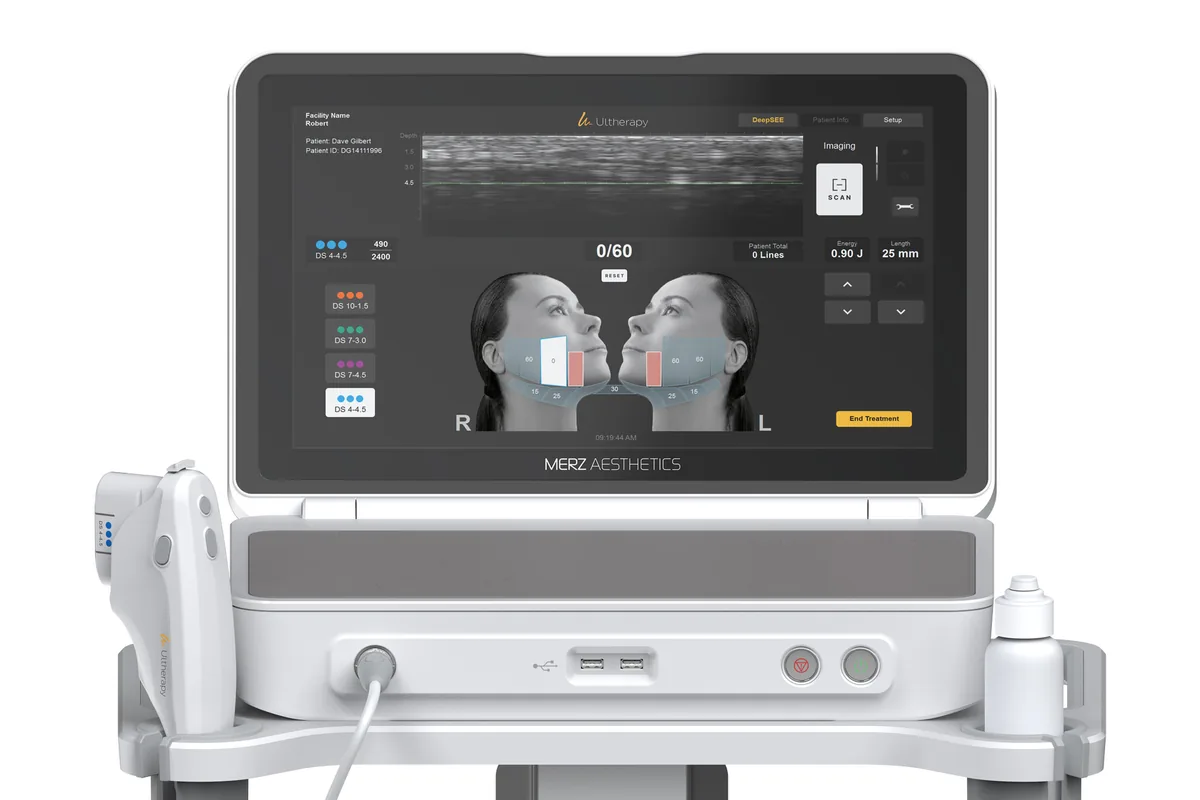
Ultherapy PRIME delivers focused ultrasound to the deeper supporting layer around the facial muscles, while Thermage FLX delivers radiofrequency energy to the dermis, the deeper layer of the skin. Which one fits depends on where the sagging starts: in thin, loose skin, in the deeper support that keeps facial tissue anchored, or in both. At BAID in Apgujeong, Seoul, the face is examined before any device is chosen.
What does each device actually treat?
| Ultherapy PRIME | Thermage FLX | |
|---|---|---|
| Energy | Micro-focused ultrasound | Radiofrequency, with the skin surface cooled first |
| Main target | The fibrous layer (fascia) that wraps the facial muscles | The dermis |
| What the doctor is looking at | Whether the deeper supporting tissue has loosened, which is often noticeable along the jawline | Whether the skin itself has become thin and stretches too easily |
| Device generation at BAID | PRIME (the newer generation of Ultherapy) | FLX (the fourth generation of Thermage) |
BAID's lead physician, Dr. Nam Ho-seok, explains both in terms of layers. With Ultherapy, heat is delivered to the membrane around the muscle with the aim of encouraging that layer to regenerate and tighten. With Thermage, the primary purpose is regenerating the dermis.
How is the choice made for a particular face?
Dr. Nam Ho-seok has said that many people receive lifting treatments without knowing which layer each one acts on, so his consultation starts by separating the face into three layers.
"I usually draw a picture of three layers: skin, fat and muscle," he explains. The skin layer points toward a device such as Thermage FLX. Excess fat points toward a different kind of treatment altogether. A loss of support across the whole face, especially along the jawline, points toward Ultherapy PRIME.
Two simple checks are part of the examination.
- Posture first. Back and neck upright, chin tucked in as if making a double chin on purpose, neutral expression. This makes the jaw outline and any volume under it easier to see.
- A gentle pull on the skin. If the skin can be drawn out past the jawline, or stretches far more than expected, Dr. Nam Ho-seok reads that as low skin elasticity and a thin dermis. In his words, if the skin stretches unusually easily, Thermage would be a good fit.
The order of priority differs from person to person, as Dr. Nam Ho-seok puts it. So the real question is less "which device is stronger" and more "which layer comes first for this face"; whether both are planned, and in what order, is decided after the examination.
Why does Thermage come up even when sagging is mild?
Dr. Nam Ho-seok compares Thermage to foundation in makeup: the layer applied first, underneath everything else. He once suggested it mainly to patients in their 40s and older, because the change is subtle. Over time he came to feel that treating the skin, pores or sagging without first looking after the dermis puts things in the wrong order, and he now discusses it with patients in their 30s as well.
He also notes that the visible change tends to be smaller in younger skin and larger in older skin, so age alone does not decide it.
When might a doctor hold off on one of these devices?
The doctors at BAID may hold off on Ultherapy or Thermage in situations such as these:
- a recent Ultherapy or Thermage session, because time between sessions matters (the appropriate interval is explained at consultation);
- a younger face with little sagging, where some doctors do not actively recommend lifting yet;
- skin elasticity being a lower priority than other concerns, where Thermage may come later (Thermage only);
- little facial fat or a face that already looks hollow, where some doctors reduce the number of shots, treat only certain areas, or do not recommend it (Ultherapy only).
Each doctor's criteria differ slightly, and the final decision follows an in-person examination.
Frequently asked questions
Q1) Which hurts more, Ultherapy or Thermage?
A1) Discomfort varies widely from person to person. A full Thermage session is not short, and Dr. Nam Ho-seok notes that most patients tolerate it well while some find it harder. If it becomes too uncomfortable, the energy can be adjusted.
Q2) How long do the results last, and how often should it be repeated?
A2) This is one of the questions the doctors hear most. It varies by individual and by device, and is explained at consultation based on the face and treatment history.
Q3) Can both devices be planned together?
A3) Sometimes both are discussed. Whether both are planned, and in what order, depends on which layer comes first for the face and on the dates of any recent sessions, so it is decided after an in-person examination.
Depending on the individual, you may feel hot or tingling pain during Ultherapy Prime, and redness, swelling, bruising, and temporary numbness or altered sensation may occur after the procedure. In rare cases, burns or blisters may occur. Results and how long they last vary from person to person, so please consult thoroughly with your doctor before deciding.
Depending on the individual, you may feel heat and pain during Thermage FLX, and redness and swelling may occur after the procedure. In rare cases, burns, blisters or scabs may occur. Results and how long they last vary from person to person, so please consult thoroughly with your doctor before deciding.