A lifting clinic is easier to judge by how the first consultation runs than by its list of devices. Five things are worth checking before booking: whether a doctor examines the whole face before a device is named, whether the clinic will say when a treatment should wait, whether the exact device is named (for Thermage FLX, with a genuine-tip confirmation stating the number of shots), whether patients are pressured to buy a package on the first visit, and how language, cost and timing are handled for a short stay. Below is how each of these works at BAID in Apgujeong, Seoul.
Does a doctor examine the face before a device is chosen?
Gangnam clinics list many lifting devices side by side. Dr. Nam Ho-seok, the lead physician at BAID, has named the problem directly: a long list of devices is marketed for lifting, and in his experience many patients undergo these treatments without knowing which tissue layer each one targets, regarding all of them simply as lifting devices.
His way of answering that is to draw the face in layers. "I usually draw the three layers for patients: skin, fat and muscle," he explains. Skin laxity, excess fat and loosened deeper support call for different tools, and treatment priorities depend on which layer needs attention first in that particular face.
At BAID the doctor looks at the whole face and sets out a longer-term plan rather than answering a single request, and the design is marked out with the patient seated before the treatment begins. Dr. Nam Ho-seok also uses a mirror at this stage. Most faces have one side that sags more or carries more volume, so he shows it and says, in his words, "This side is fuller, so we'll start here."
Will the clinic say when a treatment is not the right choice yet?
It is worth asking how a doctor decides that a treatment is appropriate for a particular face. Each of BAID's doctors has their own criteria for when to hold back, and those criteria are not identical. For thread lifting, the reasons given for suggesting another approach first include:
- It would be the patient's first aesthetic treatment, with little previous experience of other procedures.
- The patient is younger (under 40), or has never had Ultherapy.
- There is little facial fat, so there is no volume to reposition, or no hollow area for it to fill.
- The cheekbones are prominent, or there is a lot of volume around the outer cheek, where threads could make the outer contour look wider.
For energy-based lifting devices, Dr. Nam Ho-seok does not recommend repeating Thermage within six months of a previous session, or Ultherapy within three months. The dates of any recent treatment abroad therefore matter, and should be sent before the visit.
Is the exact device named, and is anything confirmed in writing?
Patients traveling for treatment are entitled to know precisely what will be used. BAID names its devices and threads by their product names:
| Treatment | What is used at BAID | What the patient can ask for |
|---|---|---|
| Ultherapy PRIME | Micro-focused ultrasound device (the newer generation after Ultherapy) | The device name and the planned treatment areas |
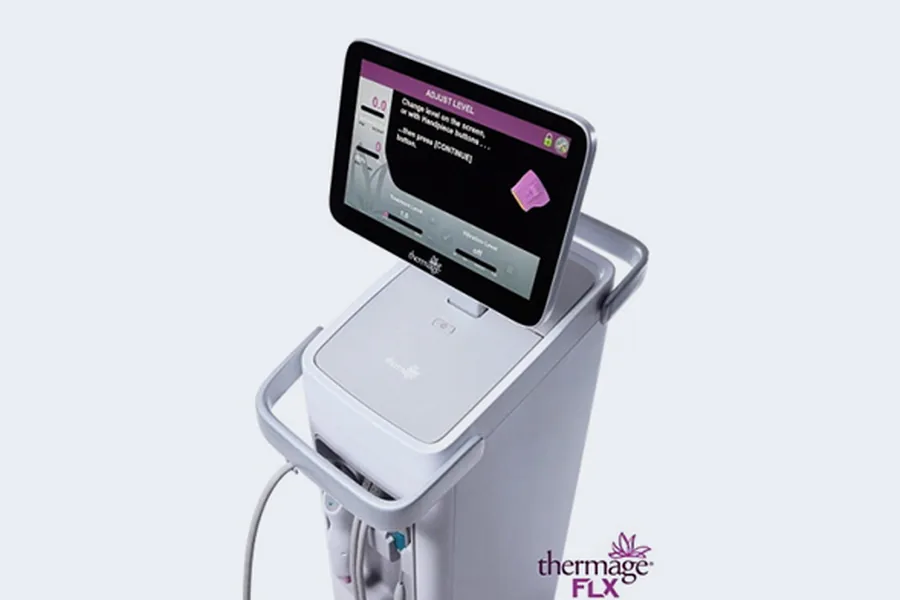
| Thermage FLX | Radiofrequency device (fourth generation, after Thermage CPT), used with genuine tips approved by the Korean Ministry of Food and Drug Safety | A genuine-tip confirmation document stating the number of shots |
| Thread lifting | MINT threads (PDO) and Silhouette Soft | Which thread is planned, and why |
The clinic's stated principle is "genuine products and the correct quantity." Patients who need an English summary of the treatment for their own doctor at home should request it before the visit, so the clinic can confirm what it can provide.
Will a package be pushed on the first visit?
Asked in an interview whether patients should buy a package from the very first session, Dr. Nam Ho-seok answered, "I don't usually recommend that." He was speaking about toning laser packages, but his reasoning applies to choosing any clinic: a patient needs to trust the treatment, understand its effect and experience the clinic first. "Trusting without understanding can actually be more dangerous," he added, and for that reason he would rather a patient try a single session and decide carefully.
For a visitor with only a few days in Seoul, it is worth asking before buying a package whether a single session is appropriate, and what follow-up may be needed.
What should a short stay in Seoul be planned around?
- Language. Dr. Nam Ho-seok, the lead physician, communicates in English; please confirm when booking which doctor will see you. A Chinese-speaking staff member is on site (hours are in the FAQ below), and an interpreter can be arranged for other languages. Please mention the language you need when booking.
- Cost. Final treatment fees are confirmed after the consultation, once the plan for that face is clear.
- Timing. Recovery time, how soon after treatment a return flight is reasonable, and how many days to allow in Seoul depend on the treatment and the individual. These should be discussed with the treating doctor at consultation, ideally before flights are booked.
- Location. BAID is near Exit 4 of Apgujeong Station.
Frequently asked questions
Q1) Can the consultation be held in English or Chinese?
A1) Dr. Nam Ho-seok, the lead physician, communicates in English; please confirm when booking which doctor will see you. A Chinese-speaking staff member is available on weekdays 10:00–18:00 and Saturdays 10:00–16:00, Korea time. An interpreter can be arranged for other languages, so please mention the language when booking.
Q2) Who carries out treatment at BAID?
A2) Treatment is carried out by BAID's doctors. Dr. Nam Ho-seok, the lead physician, is a family medicine specialist (certified in South Korea, 2017). Which doctor will examine you can be confirmed when the appointment is made.
Q3) Can the full price be confirmed before arriving in Seoul?
A3) The final fee is decided after the consultation, once a treatment plan has been set for your face. Please ask about this when booking.
Depending on the individual, you may feel hot or tingling pain during Ultherapy Prime, and redness, swelling, bruising, and temporary numbness or altered sensation may occur after the procedure. In rare cases, burns or blisters may occur. Results and how long they last vary from person to person, so please consult thoroughly with your doctor before deciding.
Depending on the individual, you may feel heat and pain during Thermage FLX, and redness and swelling may occur after the procedure. In rare cases, burns, blisters or scabs may occur. Results and how long they last vary from person to person, so please consult thoroughly with your doctor before deciding.
Swelling, bruising, pain and a foreign-body sensation may occur after thread lifting, so we recommend applying gentle cold compresses to the treated area for 3 days and sleeping in a proper position for the same period. To reduce the risk of the threads moving or breaking, take care not to open your mouth wide for 4 weeks. Asymmetry or a feeling that the threads can be felt under the skin may occur, and infection may rarely occur. You will take prescribed medication to prevent inflammation, and you must tell us if you have a medical history such as an antibiotic allergy. Results and how long they last vary from person to person, so please consult thoroughly with your doctor before deciding.